

Title: A Fossil Named “Pete”: Dayton’s Trilobite Story
Intro: Did you know that Ohio has a state invertebrate fossil? The trilobite genus Isotelus became the official state invertebrate fossil in 1985, thanks to a group of visionary Daytonians who were inspired by a fossil named “Pete”. Check out the three-part blog series below to learn more about “Pete” and Dayton’s role in this story.
Part 1: Dayton Under the Sea
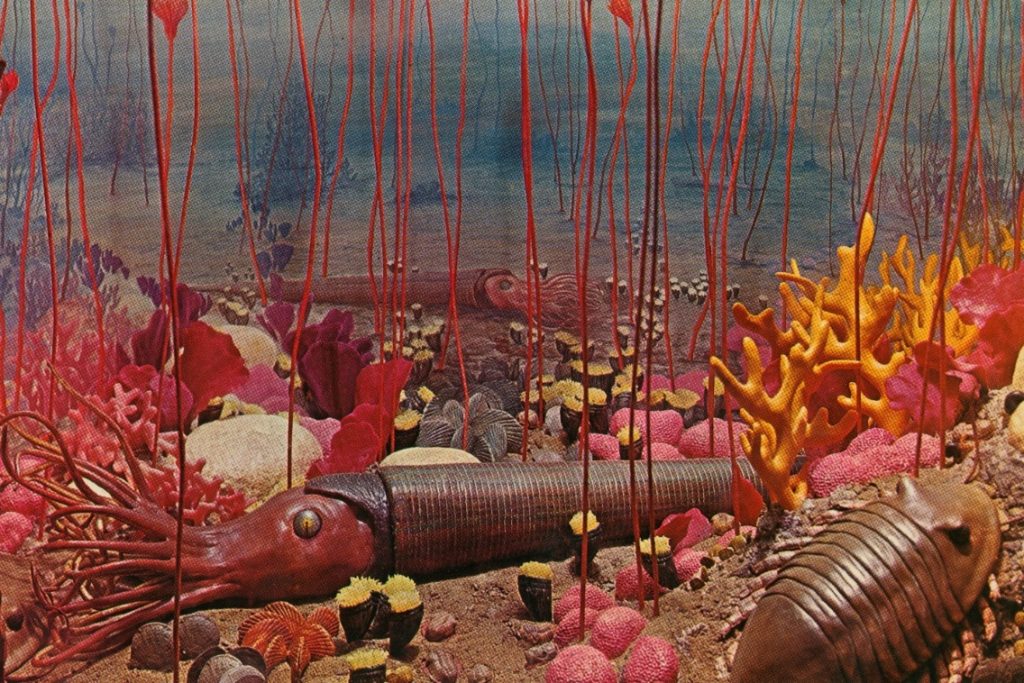
Our story begins approximately 450-445 million years ago during the Late Ordovician. During this time, the area now known as southwestern Ohio was roughly 20 degrees south of the equator and covered in a shallow, warm sea.
This tropical sea was filled with life — mostly invertebrate animals, or animals without a backbone. There were crinoids, also known as sea lilies; colony-forming filter-feeders called bryozoans; organisms with a bivalve shell known as brachiopods; and cephalopods, a relative of the modern squid that preyed on the star of this blog, the trilobite. Today, fossil remains of these animals are preserved in the limestone and shale of southwestern Ohio.
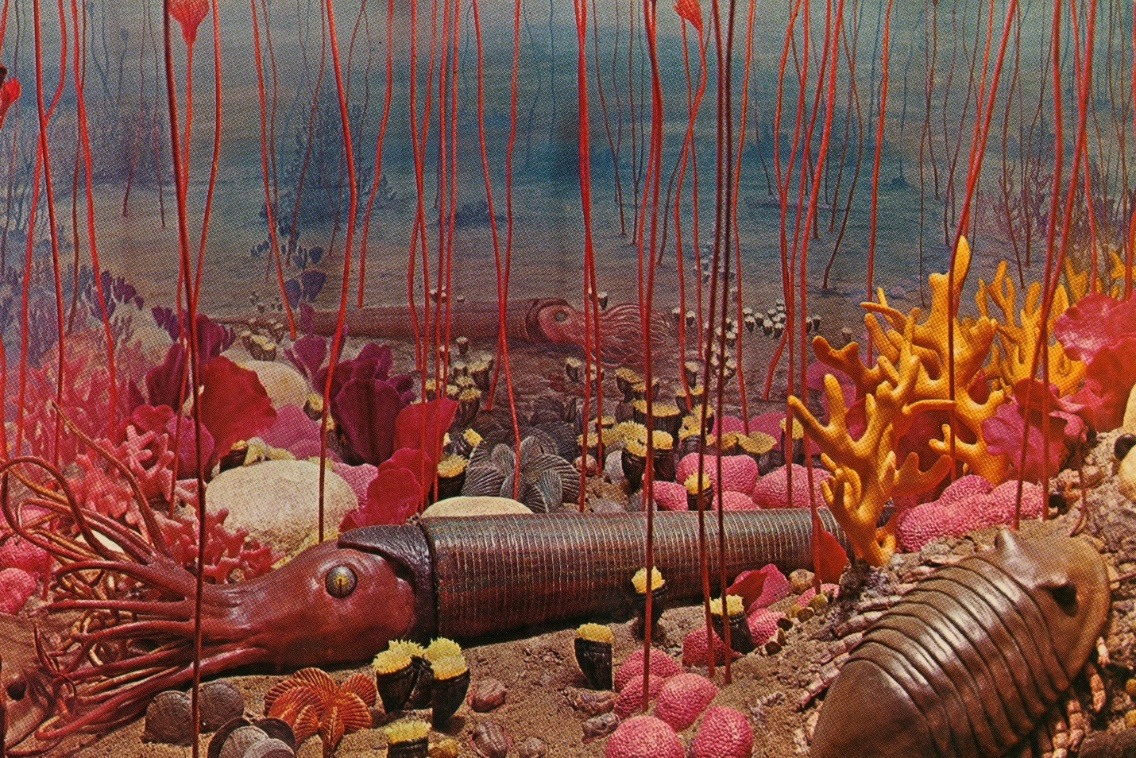
Caption: “Dayton Under the Sea”: a diorama of Ordovician life created in the 1950s that can be seen on display at the Boonshoft Museum of Discovery.
Trilobites are extinct marine arthropods, distantly related to modern arthropods such as insects, spiders, scorpions, millipedes, and horseshoe crabs. Trilobites flourished across the globe for roughly 300 million years. They first appeared over 500 million years ago during the Cambrian and became extinct approximately 251 million years ago during the Permian-Triassic mass extinction event, which saw the loss of over 90% of species on the planet.
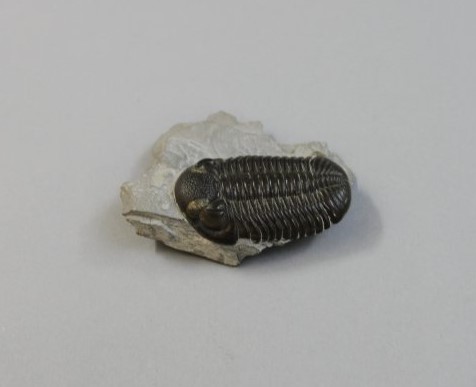
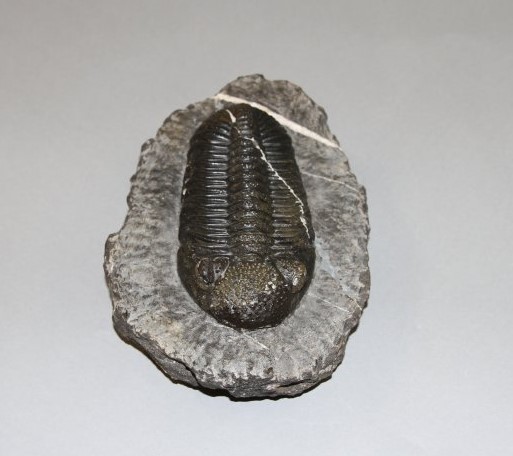
Caption: Two trilobite specimens of the species Eldredgeops rana (synonym Phacops rana). On the left is a specimen from Northwestern, Ohio (DSNH# G-28505) and on the right is a specimen from Morocco (DSNH# G-28427).
Trilobites get their name from the three lengthwise lobes of the body (the central axial lobe and two pleural lobes). They had a hard, segmented exoskeleton called a carapace with a head (cephalon), thorax, and tail (pygidium). This segmented exoskeleton allowed them to enroll or roll up for protection (like a pill bug or “roly-poly”).
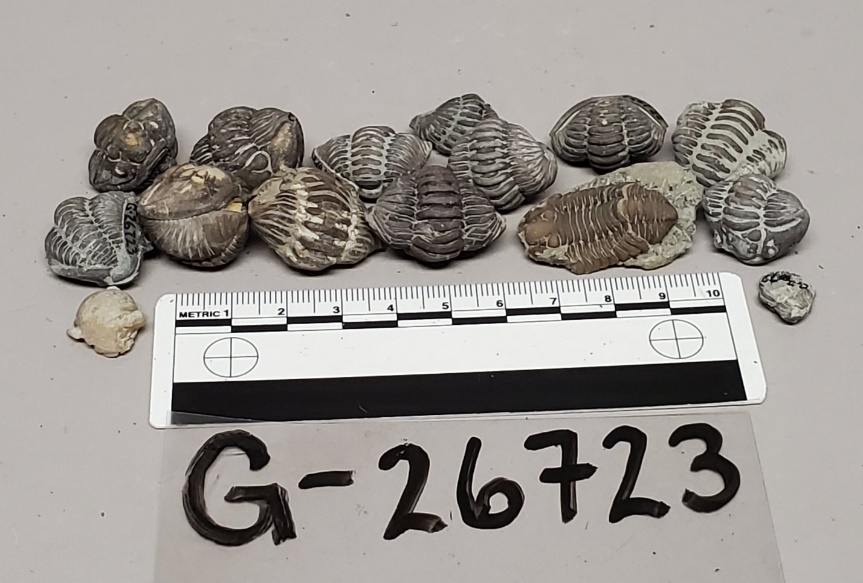
Caption: A collection of trilobite specimens of the species Flexicalymene meeki, including many enrolled specimens, from Waynesville, Ohio (DSNH# G-26723).
As they grew, trilobites would molt, or shed, their exoskeleton or carapace. These molts are common in the fossil record because the carapace was made of calcite and chitin, hard materials that had a better chance of avoiding destruction by scavengers, storms, etc. and becoming fossilized. Plus, an individual trilobite could shed many molts over the course of its lifetime, which meant that there were multiple opportunities for potential fossilization. Due to the segmented nature of the carapace, it is more common to find fragmented pieces of the molt rather than a complete exoskeleton.
Even though the hard parts of the trilobite preserved far better over time, a few exceptionally preserved fossils tell us a lot about the soft underside of trilobite anatomy. For example, we know that trilobites had jointed legs (like all arthropods), gills, and antennae. They also had a hard structure called the hypostome under the head which protected the mouth. Because the soft parts of the trilobite were so well protected, it is often assumed that a completely outstretched fossil is a molt whereas an enrolled specimen may be a trilobite that passed away.
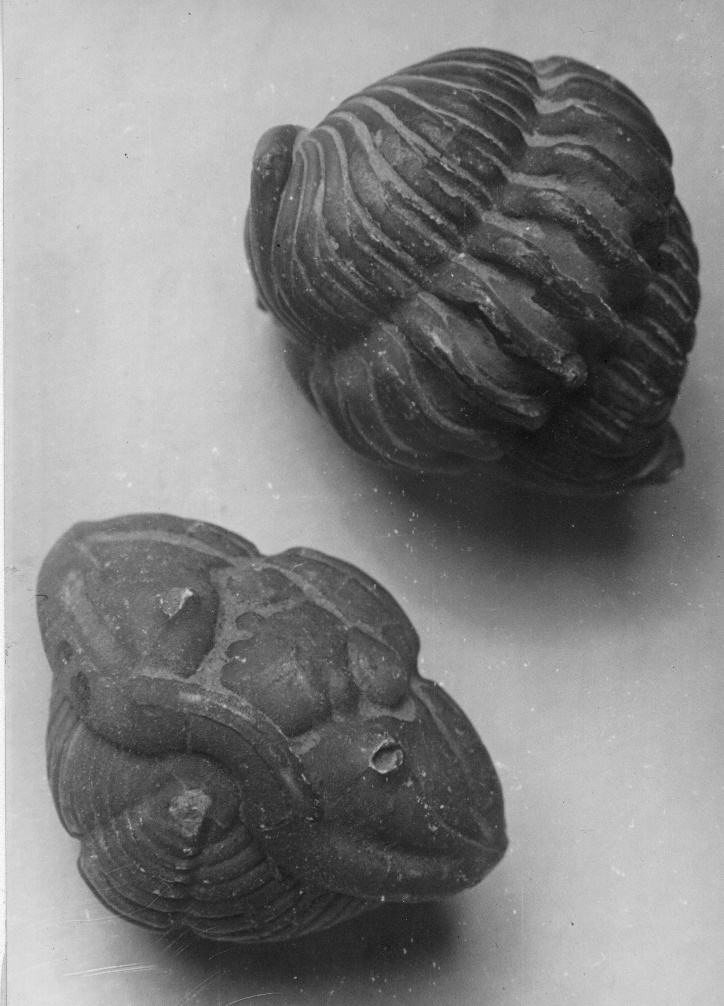
Caption: Trilobite specimens, DSNH Collection.
So far, over 20,000 different species of trilobites have been recorded with stunning variety. Trilobites ranged in size from mere millimeters to over 70cm (28 inches) long. Certain species crawled or burrowed across the ocean floor, while others swam freely through the water. Feeding strategies also differed. Some trilobites were predators or scavengers, others filtered food from the water. Vision varied as well; some trilobites had complex, compound eyes with calcite lenses that transmitted light, while others lacked sight entirely. For protection, several species of trilobites were armed with sharp spines.
Part 2: A Fossil Named “Pete”
Many different species of trilobites are found in Ohio dating from the Cambrian to the Mississippian, but the largest Ohio species is Isotelus maximus found in rocks from the Late Ordovician (450-445 million years ago).
Isotelus is a genus of large trilobites whose scientific name denotes that the head and tail are approximately the same size. This genus was first recorded by Dekay in 1824 with the discovery of the species Isotelus gigas in Trenton Falls, New York.
Trilobites in the genus Isotelus had eight segments on the thorax and eyes elevated from the head or cephalon. These trilobites were predators and/or scavengers that likely hunted worms and other invertebrates. It is thought that they burrowed partially under sediment on the sea floor with only their eyes exposed to hunt.
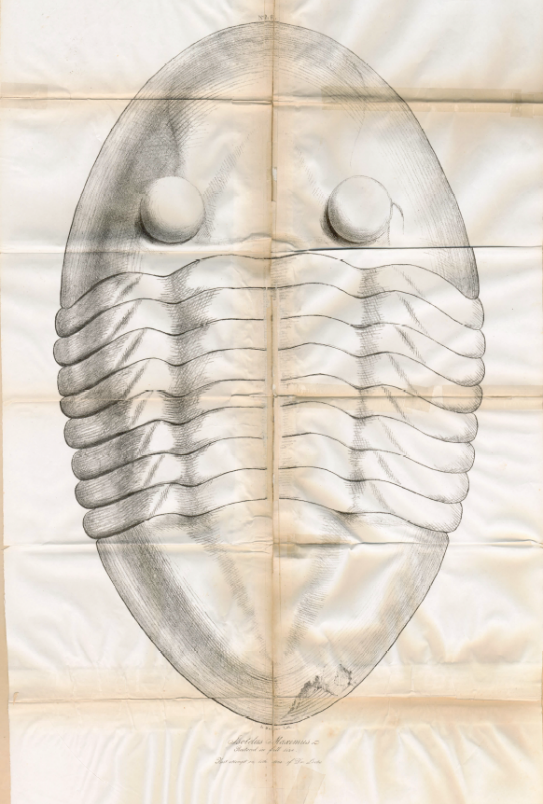
Caption: Drawing of an imagined complete Isotelus maximus from the Second Annual Report on the Geological Survey of the State of Ohio, 1838. Courtesy of the Ohio Geological Survey.
Isotelus maximus was first recorded and named by scientist John Locke during his work on the 1837-1838 Geological Survey of Ohio. Locke found partial remains (the pygidium or tail) of a trilobite specimen in Adams County, Ohio, and estimated that the total length would have been 21 inches. No one could have anticipated how much attention this species of trilobite would receive in the coming decades.
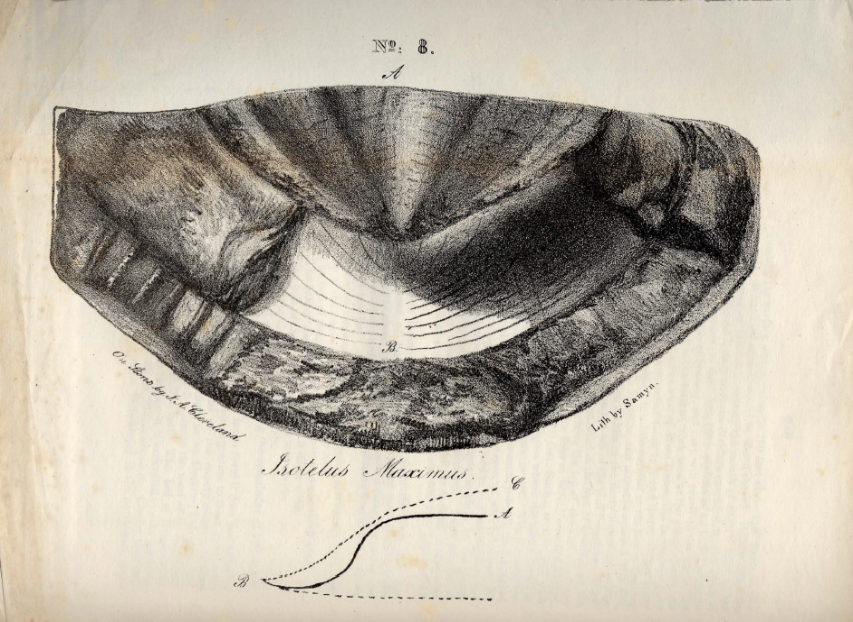
Caption: Figure of a partial specimen of Isotelus Maximus from the Second Annual Report on the Geological Survey of the State of Ohio, 1838. Courtesy of the Ohio Geological Survey.
In the Spring of 1919, construction crews from the Miami Conservancy District (MCD) were hard at work at the Huffman Dam site on the Mad River near present-day Fairborn, Ohio. The MCD had been created in June 1915, in response to the deadly 1913 flood, and had set out to build five earthen dam structures across the region to prevent future mass flooding.
That Spring, Cloyde C. Chambers (1886-1964), consulting engineer for MCD and division engineer for Huffman Dam, and a crew were digging below river level for the Huffman Dam outlet when they discovered an unusually large fossil, at first thought to be a turtle.
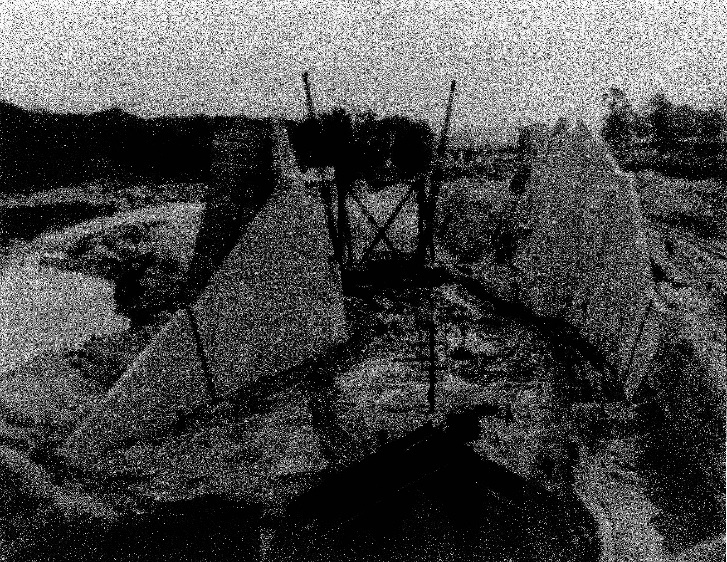
Caption: Huffman Dam construction.
The fossil was given to MCD’s Chief Engineer Arthur Ernest (A.E.) Morgan (1878-1975), who had urged crews to be on the lookout for fossils. Morgan was selected as MCD’s Chief Engineer due to his reputation for drainage and flood control engineering. He would go on to have a prolific career, serving as President of Antioch College, and as the Chairman of the Tennessee Valley Authority.
A.E. Morgan presented the fossil (which was realized to be a trilobite) to his son Ernest for his school’s museum at Moraine Park School, but it soon became clear that this specimen was special. Shortly after the discovery, the fossil started to gain attention in the local paper with its unusual size of 14 ½ inches long, 10 ¼ inches wide.
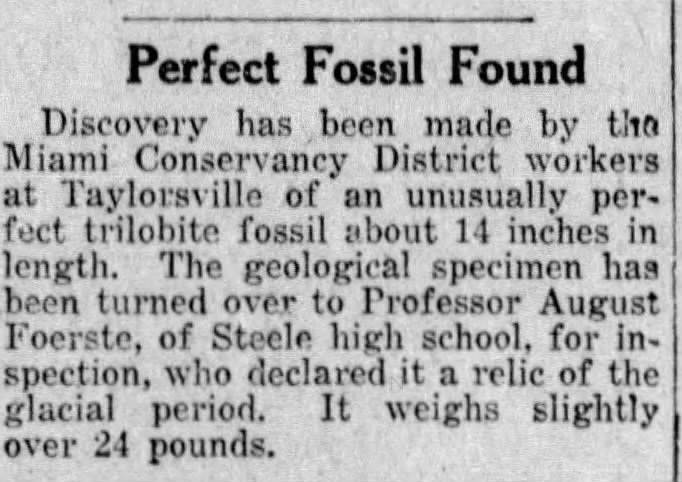
Caption: The Dayton Daily News April 30, 1919.
The Morgan family took the fossil to Dr. August Foerste (1862-1936), a teacher at Dayton’s Steele High School, who was a world-renowned geologist and paleontologist. Dr. Foerste was also a supporter, donor, and researcher for the Dayton Museum of Natural History (today’s Boonshoft Museum of Discovery). Born in Dayton, Dr. Foerste had studied at Denison University, earned his Ph.D. from Harvard, and published a book titled, The Geology of Dayton and Vicinity. He also worked for the United States Geological Survey and studied invertebrate paleontology at the National Museum (the Smithsonian National Museum of Natural History).
Foerste believed the Huffman Dam trilobite to be the largest, most complete trilobite specimen at the time and thought that it might be a new species. In July 1919, the New York State Museum offered $200 for the specimen but newspapers mention that the offer was declined due to the desire to make it accessible to the largest number of people possible.
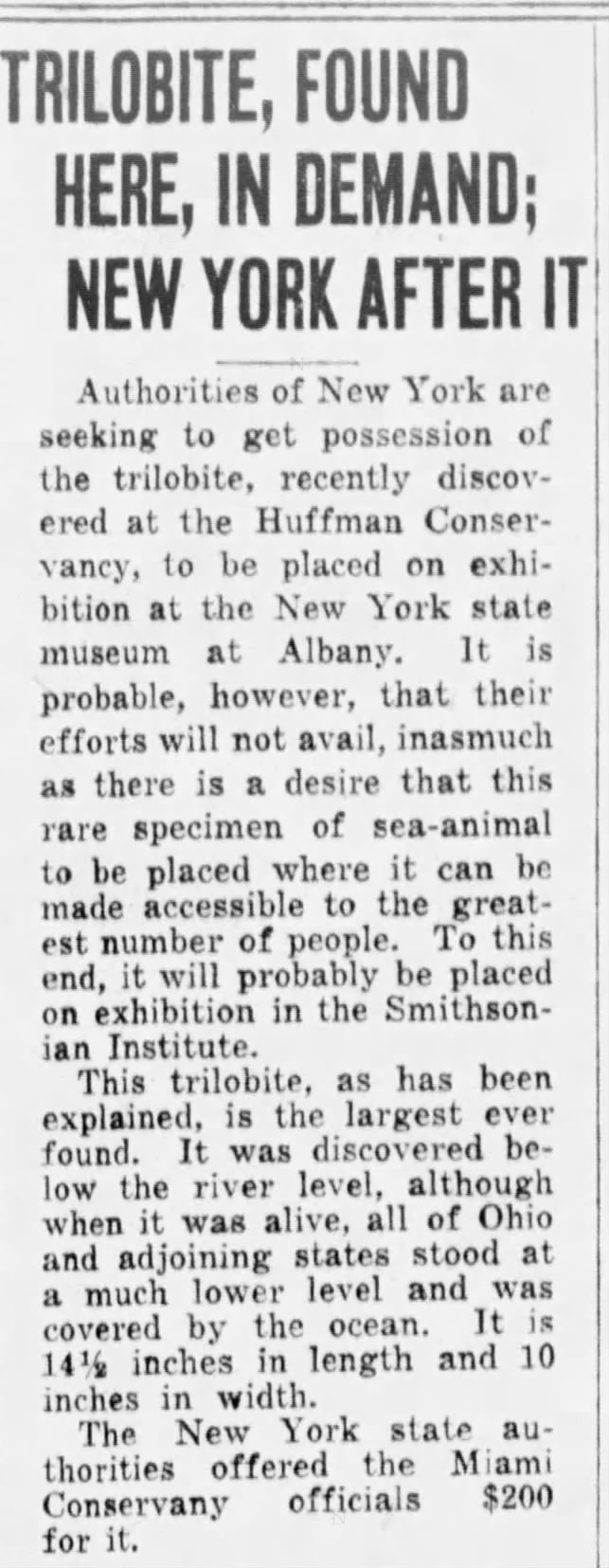
Caption: The Dayton Daily News July 22, 1919.
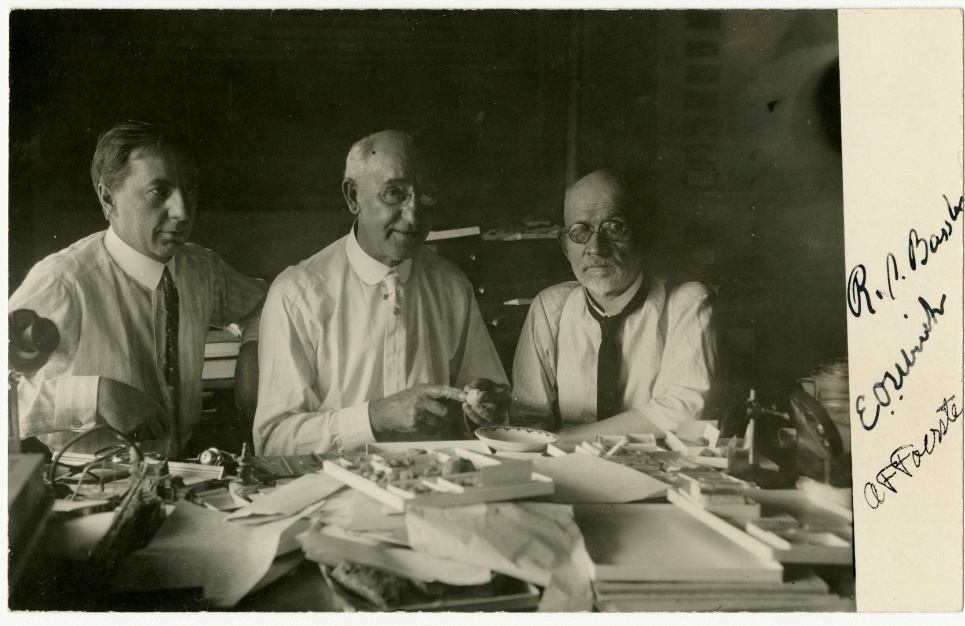
Caption: Dr. August Foerste pictured (right) with Curator Raymond Bassler of the Smithsonian and geologist Edward Oscar Ulrich.
Thanks to Dr. Foerste’s connections at the Smithsonian, the idea of the specimen going to the National Museum started to gain traction. Meanwhile, the specimen was on display at the MCD offices in downtown Dayton. In September of 1919, Foerste published an article in the Bulletin of the Scientific Laboratories of Dennison University designating it as a new species Isotelus brachycephalus (meaning shortened or broad head). However, he also acknowledged that due to limited evidence, it might be possible that the more elongate specimens (Isotelus maximus) and broader forms (Isotelus brachycephalus) represented differences between male and female trilobites of the same species rather than separate species.
In October 1919, the press declared that this famous trilobite had been nicknamed “Pete.” But sadly, despite research efforts, it is still unclear as to where this nickname originated. Our Curator, Jill Stover, has a theory that the name may be in remembrance of the Dayton Museum of Natural History’s custodian (or director/curator) Peter S. Eikenbary who passed away in 1919, the same year the trilobite was discovered.
In the Fall of 1919, A.E. Morgan donated “Pete” to the National Museum and Smithsonian Curator Raymond Bassler traveled to Dayton to take the specimen back to D.C. where it would be given “a place of prominence”. There, the fossil would remain on display for decades.
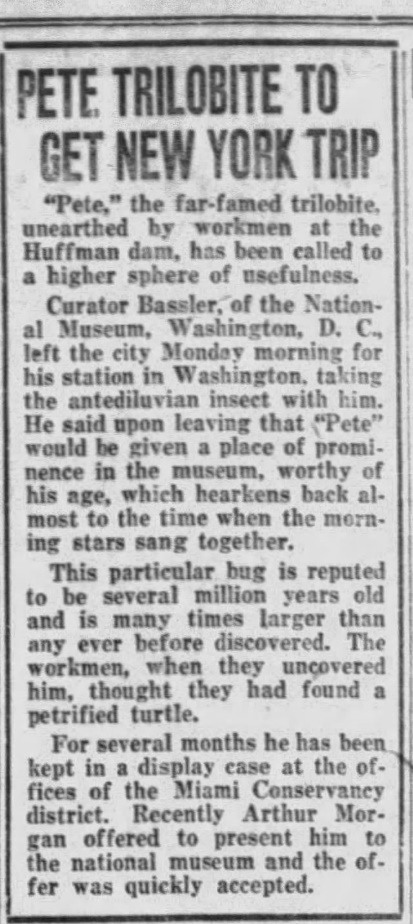
Caption: The Dayton Herald October 13, 1919.
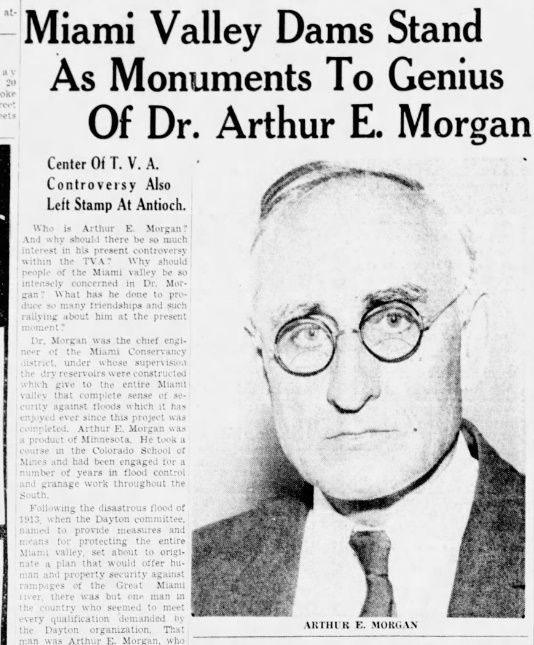
Caption: The Dayton Herald March 11, 1938.
Even though “Pete” left for D.C., Dayton’s trilobite continued to have an important legacy in its hometown. In the early 1940s, the Dayton Public Library Museum (known later as the Dayton Museum of Natural History and today as the Boonshoft Museum of Discovery) received a plaster cast of the specimen for display and it became the museum’s official seal and logo.
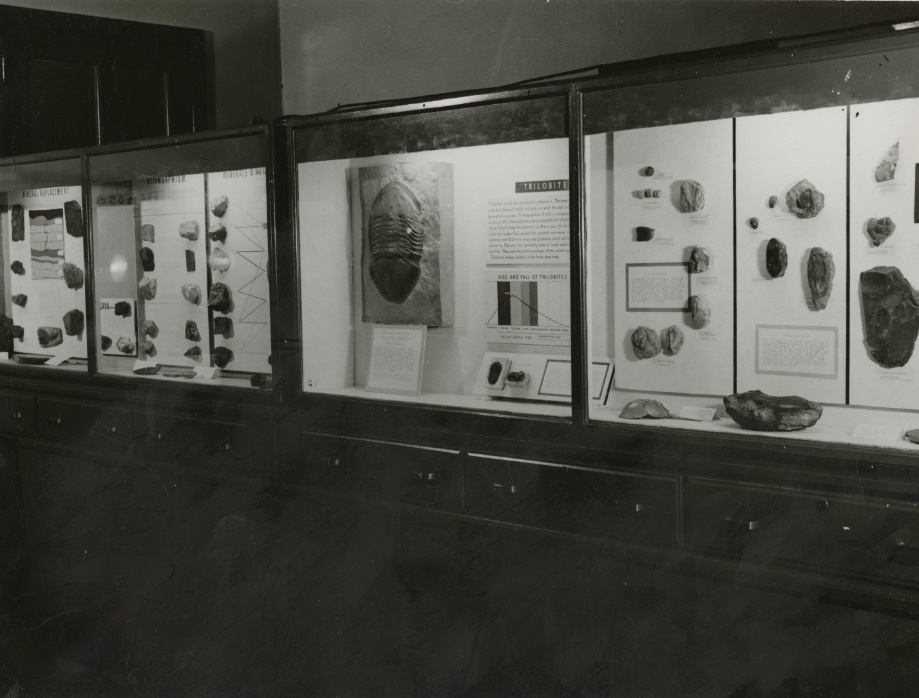
Caption: The plaster cast of the Huffman Dam trilobite on display in the Dayton Public Library Museum, circa 1940s.
In 1963, the Dayton Museum of Natural History even tried to have “Pete” return to Dayton to celebrate the museum’s 70th anniversary, but unfortunately this was not possible due to the specimen’s research potential.
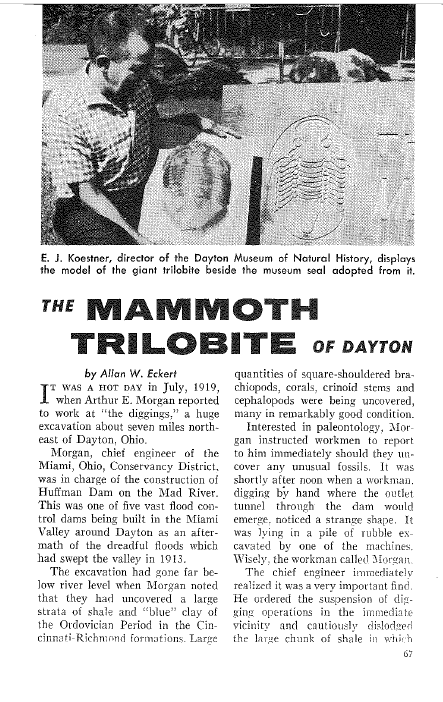
Caption: Here we have E.J. Koestner, Director of the Dayton Museum of Natural History, holding the plaster cast of the Huffman Dam trilobite alongside the museum’s entrance sign featuring the trilobite logo. Image from “The Mammoth Trilobite of Dayton” by Allan W. Eckert, Science Digest, July 1961.
Part 3: Ohio’s State Invertebrate Fossil
Fast forward to the summer of 1984. Our story resumes with two Dayton-area teachers, Virginia Evers and Doris Swabb, who are taking a course called Ohio’s Natural Heritage at the Dayton Museum of Natural History (or DMNH, known today as the Boonshoft Museum of Discovery) where they learn that New York has an official state fossil. They have decided that Ohio should have one too.
Inspired by the Huffman Dam trilobite, Virginia’s 4th graders at St. Anthony School in Dayton and Doris’s 3rd graders at Beavertown Elementary in Kettering launched a campaign to make the trilobite Ohio’s state fossil.
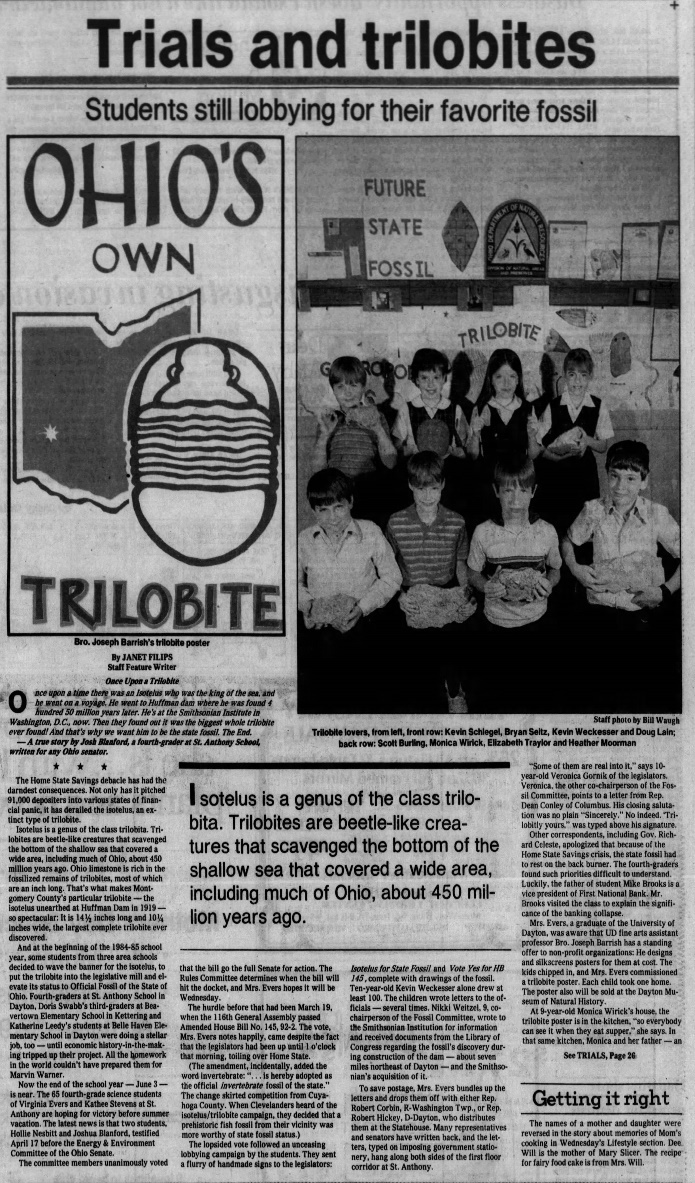
Caption: The Dayton Daily News May 10, 1985.

Caption: The Journal Herald October 29, 1984.
They received media attention, support from local geology groups, and even a letter of support from Ernest Morgan (the son of MCD’s A.E. Morgan who, if you remember, took the trilobite to display at his school’s museum back in 1919). Soon, Catherine Leedy and the students of Dayton’s Belle Haven Elementary joined the campaign.
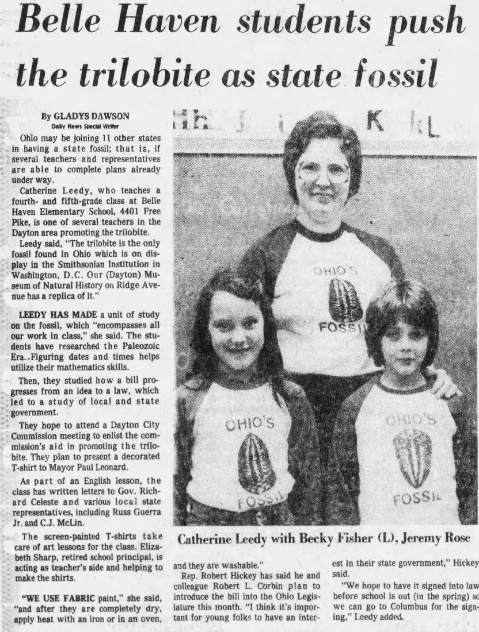
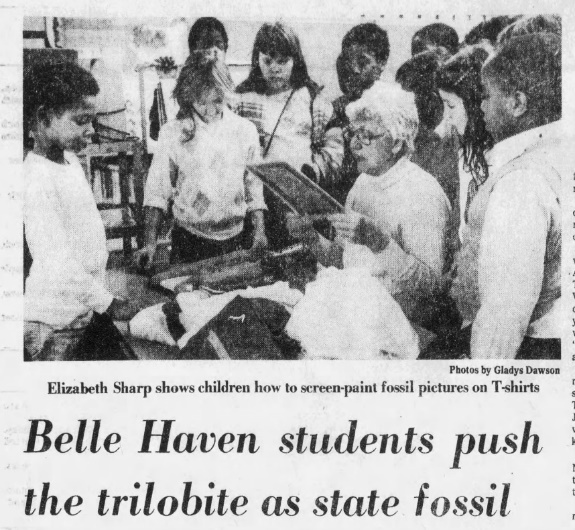
Caption: The Dayton Daily News January 16, 1985.
The students went above and beyond. They researched trilobites, searched for fossils, wrote letters to their state representatives, and corresponded with other individuals from states that had state fossils to learn more about the process. Along the way, they learned about geology, math, art, and how a bill becomes a law. Undoubtedly, it was an experience that these students never forgot.
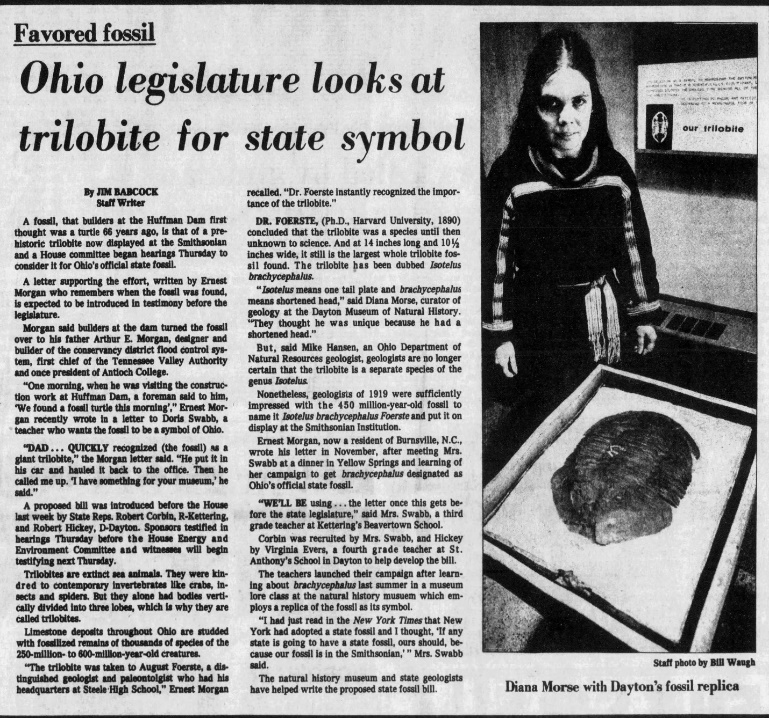
Caption: The Dayton Daily News February 2, 1985.
Diana Morse, DMNH Curator of Geology, and Michael Hansen at the Ohio Department of Natural Resources (ODNR) helped craft the bill’s language with the Huffman Dam trilobite as the reference. The bill focused on the genus Isotelus rather than species level because there was a growing understanding that Isotelus brachycephalus, the species Dr. Foerste attributed to the Huffman Dam trilobite, might be a junior synonym of Isotelus maximus rather than its own species.
Still, it was felt that Isotelus would serve as a great representation of Ohio’s fossil record, including other smaller species of trilobites. Michael Hansen stated, “Isotelus symbolizes the importance of geology and mineral resources to the state of Ohio and the wondrous diversity of past life preserved in Ohio’s rocks during the past 450 million years of earth history.”
The students continued to push forward with their creative “lobbying.” They made trilobite T-shirts and presented one to Dayton’s Mayor Leonard. Viriginia Evers commissioned a silk screen poster by University of Dayton’s Fine Arts Assistant Professor Bro. Joseph Barrish. The students baked trilobite cookies with chocolate chip eyes and sent them to Ohio politicians. Some students even traveled to the Ohio Senate hearing (along with the museum’s trilobite cast).
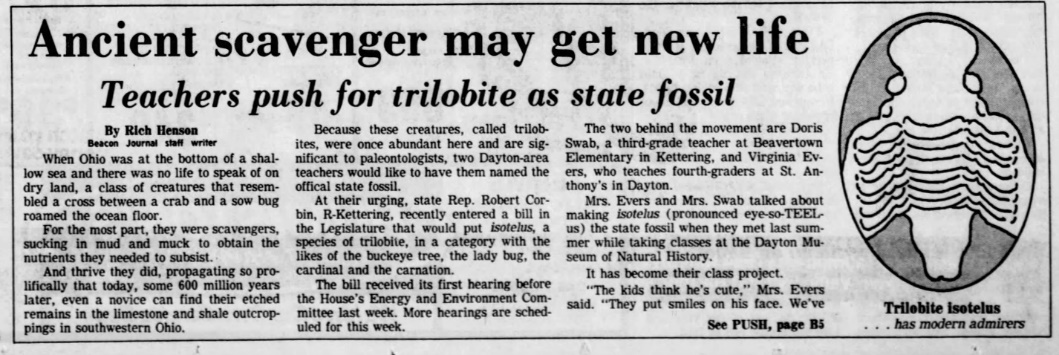
Caption: Akron Beacon Journal February 19, 1985.
As a result of the students’ efforts, Ohio Representatives Robert Corbin and Robert Hickey introduced the bill in January 1985, and Senator Charles Horn sponsored the bill in the Ohio Senate. Many of the representatives were inspired by the students’ dedication and joined in on the fun, such as Representative Dean Conley who signed a letter back to the class at St. Anthony with “Trilobitly yours.” The bill passed both the Ohio House and Senate with very minimal opposition. At one point, the bill was amended to distinguish Isotelus as the state invertebrate fossil in order to leave room for potential future state fossil designations (shout out to “Dunk”).
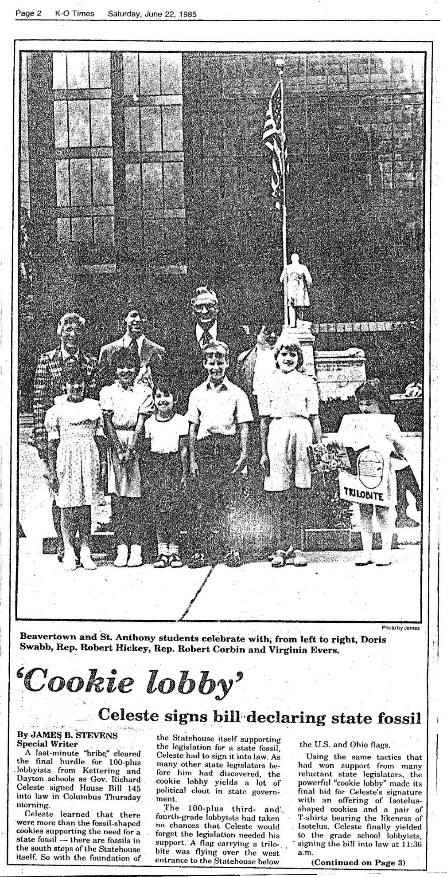
Caption: K-O Times June 22, 1985.
Ohio Governor Richard Celeste signed Ohio House Bill 145 at 11:36 am on June 20, 1985, declaring Isotelus as Ohio’s state invertebrate fossil. With this designation, Isotelus joined the ranks of the buckeye tree (Ohio’s state tree), the cardinal (Ohio’s state bird), and flint (Ohio’s state gemstone). It was a celebration. Over one hundred students attended the bill signing and a trilobite flag briefly flew at the Ohio Statehouse. ODNR offered cast trilobite paper weights and lapel pins/tie tacks in commemoration of the event. An exhibit was held at the Ohio State Fair in August 1985 to celebrate the designation.

Caption: The signing of Ohio House Bill 145.
In the decades following the signing of Ohio House Bill 145, it continued to be an exciting time for us Isotelus fans. Later in the 1980s, local fossil expert Tom Johnson discovered more record-sized, intact specimens in the southwestern Ohio area. In September 1986, Johnson found a specimen measuring 13 ¼ inches long, 10 ½ inches wide during an excavation in the bed of an emergency relief spillway at Caesar Creek Lake Dam in Warren County as part of an agreement between the US Army Corps of Engineers, the Smithsonian, and the Royal Ontario Museum who were undertaking a study of the genus Isotelus. Remarkably, in the Fall of 1988, Johnson discovered an even larger, complete specimen measuring 16 inches long, 10 ½ inches wide in a creek bed near West Carrollton. And in the early 2000s, a new trilobite “King” made headlines. A species known as Isotelus rex was found in Canada that measured over 28 inches long.
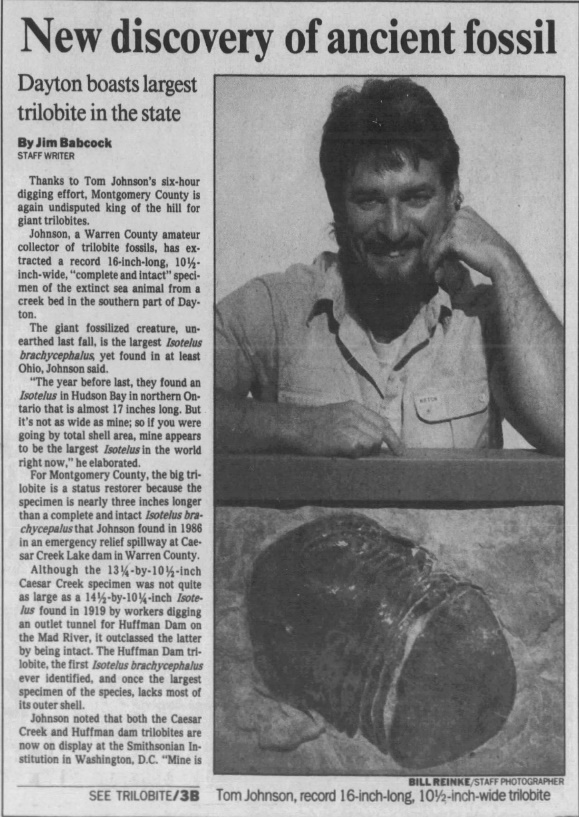
Caption: The Dayton Daily News May 7, 1989.
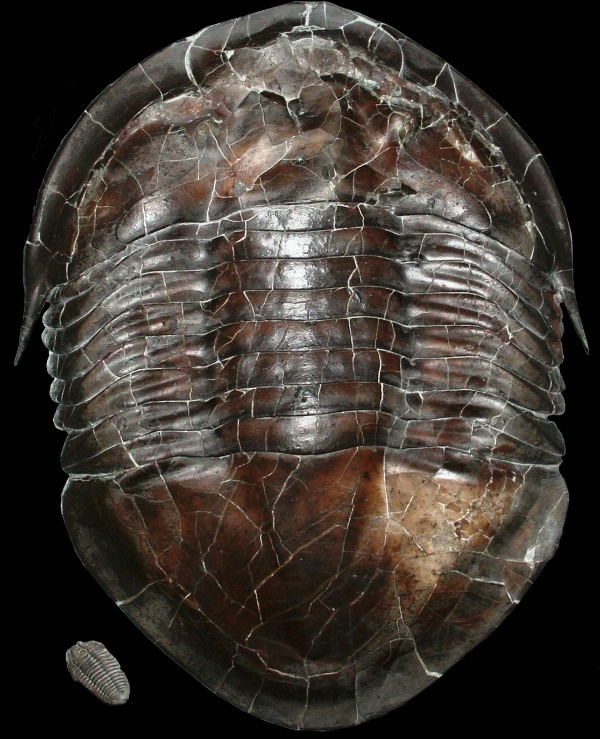
Caption: Isotelus maximus specimen from the south bank of Caesar Creek, collected by Tom Johnson, DSNH# G-28348, alongside a 3.3cm trilobite fossil for scale.
Today, the cast of “Pete” the Huffman Dam trilobite continues to play a prominent role at the Boonshoft Museum of Discovery as part of our mission to engage curious minds with natural history, science, and nature. Trilobites like “Pete” connect us to a fascinating story of life, adaptation, and death spanning hundreds of millions of years. A story that can teach us about the incredible geology of Ohio and the work of generations of inspirational Daytonians. Please come visit us at the Boonshoft Museum to check out trilobites on display in the Bieser Room of Wonders. If you want to see the large trilobite donated to the museum by Tom Johnson as well as other Ohio fossils, join the Curator’s Club and book a behind-the-scenes tour of the collections.
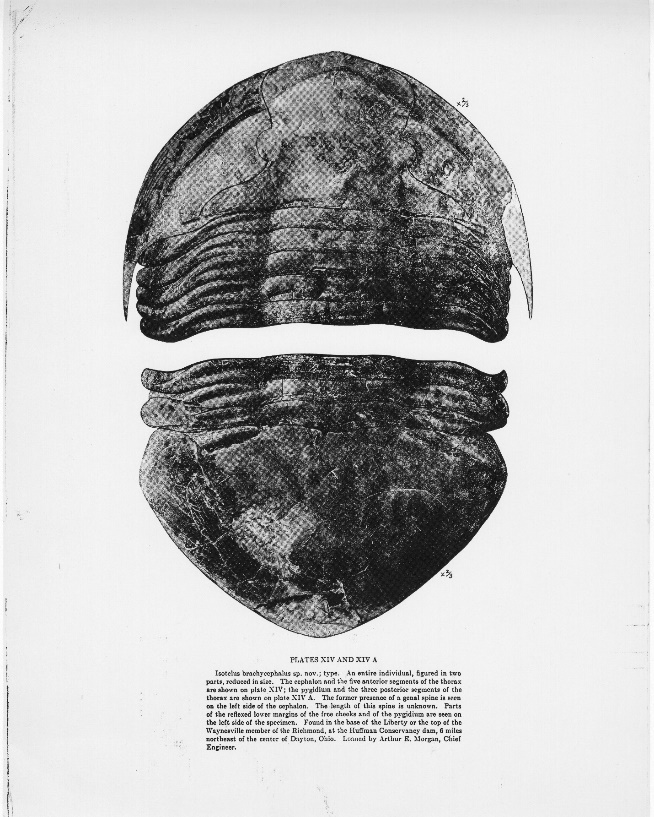
Caption: Dr. August Foerste’s illustration of the Huffman Dam trilobite. From Bulletin of the Scientific Laboratories of Dennison University, September 1919.
Our story is perhaps best summed up by a poem from Doug Lain, one of the elementary schoolers who helped make Isotelus Ohio’s official state invertebrate fossil:
“Isotelus is the best. He is better than the rest. He was found at Huffman Dam. Now he’s with Uncle Sam. Trilobites lived under the sea. In Ohio like you and me. This is all I’m going to say. So have a great trilobite day!”
Frequently Asked Questions
What is “Pete,” and where is the actual fossil today?
“Pete” is the nickname given to the unusually large trilobite discovered in 1919 during construction at Huffman Dam. The original specimen was donated to the National Museum (Smithsonian) in 1919, where it remained on display for decades.
Can I see “Pete” at the Boonshoft Museum of Discovery?
You can’t see the original “Pete” (it went to the Smithsonian), but Boonshoft’s natural history Collection includes a cast of “Pete” that is often featured in the museum’s collections programming. In addition, you can learn more about many other trilobite specimens in the museum’s online collection.
Is there an exhibit connected to the “Dayton Under the Sea” section of the article?
Yes. The article notes that “Dayton Under the Sea,” a diorama of Ordovician life created in the 1950s, is on display at the Boonshoft Museum of Discovery.
Where in the museum can visitors see trilobites on display?
The article specifically invites visitors to “check out trilobites on display” in the Bieser Room of Wonders.
Coverage of the exhibit’s concept and opening is also documented publicly.
What is Isotelus, and why is it important in Ohio?
Isotelus is the trilobite genus designated as Ohio’s official state invertebrate fossil (the campaign was inspired by the Huffman Dam trilobite story).
What kinds of Ordovician sea life does the article mention, and can Ohio fossils really preserve that story?
This article describes an Ordovician sea that once covered southwestern Ohio and names fossil groups preserved in local limestone and shale—crinoids, bryozoans, brachiopods, and cephalopods, alongside trilobites.
Do you have a large Ohio trilobite specimen at Boonshoft, beyond the “Pete” cast?
Yes. This article notes that visitors who want to see “the large trilobite donated to the museum by Tom Johnson” (plus other Ohio fossils) can do so through museum experiences connected to the collections. Visitors can also learn more by accessing the museum’s online collection.
Boonshoft also provides public information about scheduling behind-the-scenes tours.
See Ohio’s Natural History Up Close
If this story made you want to step back into the Ordovician, come visit the Boonshoft Museum of Discovery and explore natural history in person:
- Experience “Dayton Under the Sea”—the Ordovician-life diorama described in the article is on display at Boonshoft.
- Visit the Bieser Room of Wonders to see trilobites on display, and connect what you just read to real specimens and interpretation.
- Look for Boonshoft’s “Pete” connection—the museum’s cast of the Huffman Dam trilobite remains a meaningful part of how we share Dayton’s natural history legacy.
- Want to go deeper? Join the Curator’s Club and book a behind-the-scenes collections tour to see a large trilobite donated by Tom Johnson and additional Ohio fossils.
For current hours, admission, and exhibit listings, refer to our homepage for hours & admissions.